Virtual Staging vs. Misrepresentation: The 2026 Rules for Agents
26th January 2026
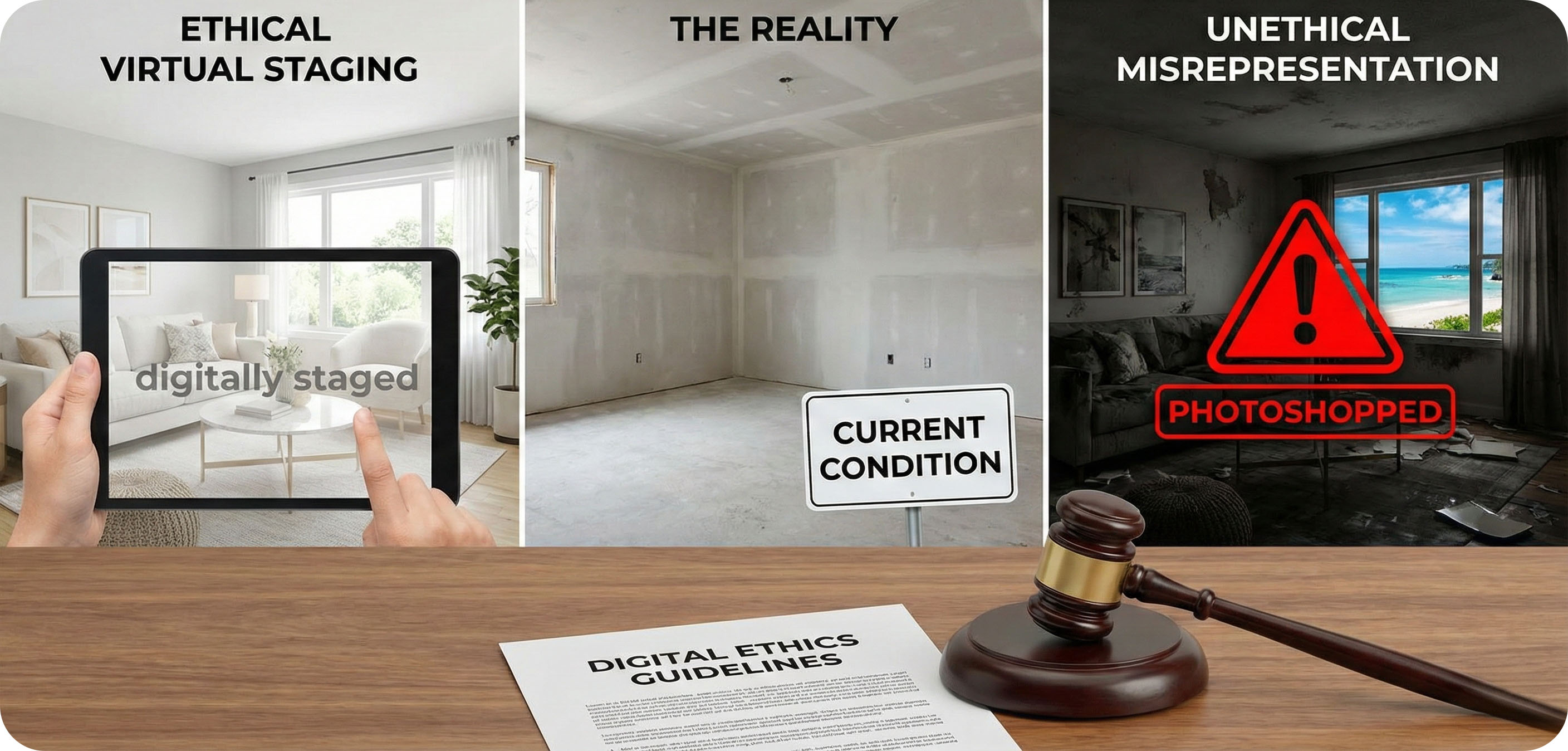
In 2026, every agent has access to “Magic Eraser” tools on their phone. With a single tap, you can remove a messy bed, wipe out a skip on the driveway, or delete a pylon from a view. But just because you can , does it mean you should?
The Consumer Protection from Unfair Trading Regulations (CPRs) haven’t changed - but the technology has. And that has created a dangerous grey area where agents can accidentally misrepresent a property by over-editing images.
So where is the line between smart marketing and risky misrepresentation? And why is the human touch still your best defence?
Virtual Staging vs. Virtual Renovation: Knowing the Difference

To stay compliant, it is vital to distinguish between the three tiers of photo editing. Trading Standards treat these very differently, and so should you.
Virtual Staging (Safe)
This involves adding digital furniture to an empty room to help buyers visualise the space and imagine how they could live there.
- The Rule: As long as the furniture is scaled correctly (i.e., you aren’t placing a “tiny” sofa to make the room look larger than it is), this is widely accepted and considered low risk.
Object Removal (Safe... When Done Correctly)
This means removing temporary clutter, such as a tenant’s laundry, a skip on the driveway, or a car blocking the main exterior shot.
- The Rule: You can remove temporary items that will not be there when the buyer moves in. You cannot remove permanent fixtures (such as a radiator, plug socket, smoke alarm, or a lamppost outside the property).
Virtual Renovation (The Danger Zone)
This involves digitally changing fixed features such as walls, flooring, kitchens, or bathrooms.
- The Rule: This is high risk. If you digitally change a carpet into wood flooring, for example, you must clearly label the image as “Concept Art” or “Potential Renovation”. If you don’t, you risk breaching Material Information requirements and misleading buyers.
The "AI Trap": Why Automated Tools Are Risky
Cheap AI tools are "blind". They don’t understand the property market — they only understand pixels.
- The Risk: An AI tool may spot a patch of damp and mistake it for a shadow, “fixing” it automatically. If a buyer then views the property and the damp is still visible, you’ve created a potential misrepresentation issue.
- The Glitch: AI can also “hallucinate” when filling in missing areas. It might accidentally remove something important, such as a structural beam or even a window handle — creating an image that no longer reflects reality.
The Solution: Why Made Snappy 360 Uses Humans, Not Just Algorithms

In a world of instant AI, Made Snappy 360 takes a different approach: Compliance through expertise.
Our Object Removal service isn’t a one-click AI button — it is handled by trained designers and professional editors. We don’t just “erase”; we perform digital reconstruction.
Here is why that matters for your agency’s safety:
Background Reconstruction (Rebuilding vs Blurring)
Imagine a photo of a living room with a large drying rack full of clothes in the centre.
- The AI approach: An automated tool identifies the rack and tries to “guess” what is behind it. This often results in a blurry smudge, a warped carpet pattern, or a skirting board that suddenly disconnects. It looks “off”, and buyers notice these glitches immediately.
- The Made Snappy approach: Our trained designers rebuild the space properly. If we remove that drying rack, we digitally restore the carpet texture, extend the skirting board in a straight line, and ensure the lighting matches the rest of the room. The room looks the way it truly does when empty.
The “Temporary vs Permanent” Compliance Test
This is where agents can get caught out. Because our editors are real people, they act as a built-in compliance filter.
- What we remove: Personal possessions and temporary clutter. This includes cars on the driveway, wheelie bins, privacy concerns (family photos and paperwork), and general tenant mess.
- The safety net: If you request removal of a radiator, plug socket, smoke alarm, or a lamppost outside the window, our team will flag it. An AI tool may simply delete it — leaving you exposed if a buyer later discovers the “clean wall” actually has fixed features in place.
Solving the “Tenanted Property” Headache
One of the biggest friction points for agents is photographing tenanted properties where the tenant hasn’t decluttered.
- Instead of arguing with a tenant or publishing messy photos that devalue the listing, Made Snappy 360 allows you to photograph the room “as is”.
- Our editors remove the clutter professionally. This keeps the landlord happy (marketable photos), the tenant happy (less pressure to deep clean), and the agent protected (the structure remains accurate).
Avoiding the “Ghosting” Phenomenon
Have you ever seen a property photo where a table was removed, but its shadow remained? Or where a reflection in a mirror showed an object that supposedly wasn’t in the room?
These are classic signs of rushed, automated editing.
- The Made Snappy 360 team checks reflections (mirrors, windows, and glossy surfaces) and shadows to ensure removals are consistent across the entire image. This attention to detail is the difference between a photo that looks “fake” and one that looks professionally edited.
Checklist: 5 Things to Check Before Uploading
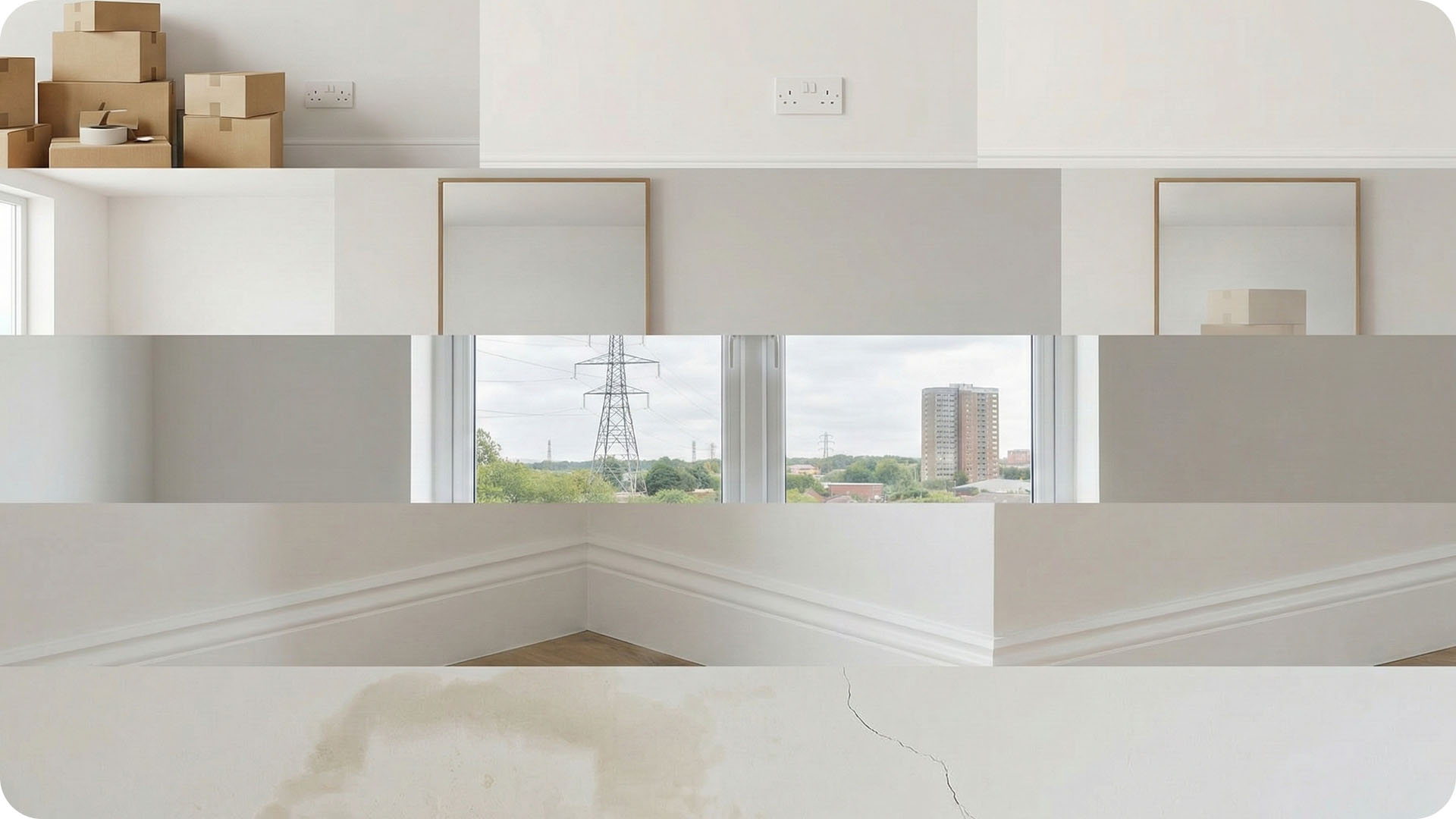
Before you push your edited photos to Rightmove or Zoopla, run them through this quick compliance check:
- The “Socket Check”: Look at the walls where items were removed. Did the editor accidentally remove plug sockets or light switches along with the clutter?
- The “Reflection Test”: Check mirrors and windows. If you removed a pile of boxes from the floor, are they still visible in the reflection?
- The “Window View”: Make sure no permanent external features (pylons, substations, neighbouring walls) have been removed from the view.
- The “Structural Integrity”: Check skirting boards and cornices behind where an object was removed. Do the lines meet up cleanly, or do they look warped?
- The “Damp & Crack” Rule: Ensure that while clutter has been removed, the condition of the walls remains honest. Never digitally repair damp or structural cracks unless the image is clearly labelled as a “renovation concept”.
Protect Your Reputation
The fastest way to lose a buyer’s trust is for them to walk into a property that looks nothing like the photos.
In 2026, high-quality, compliant visual marketing isn’t just about selling faster — it’s about selling safely.
Don’t leave your compliance to a bot. Trust the experts.


